 E Paper
ISLAMABAD (Urdu Times) CPEC Phase II, Pakistan and China Agritech B2B Investment Conference, Islamabad

Share
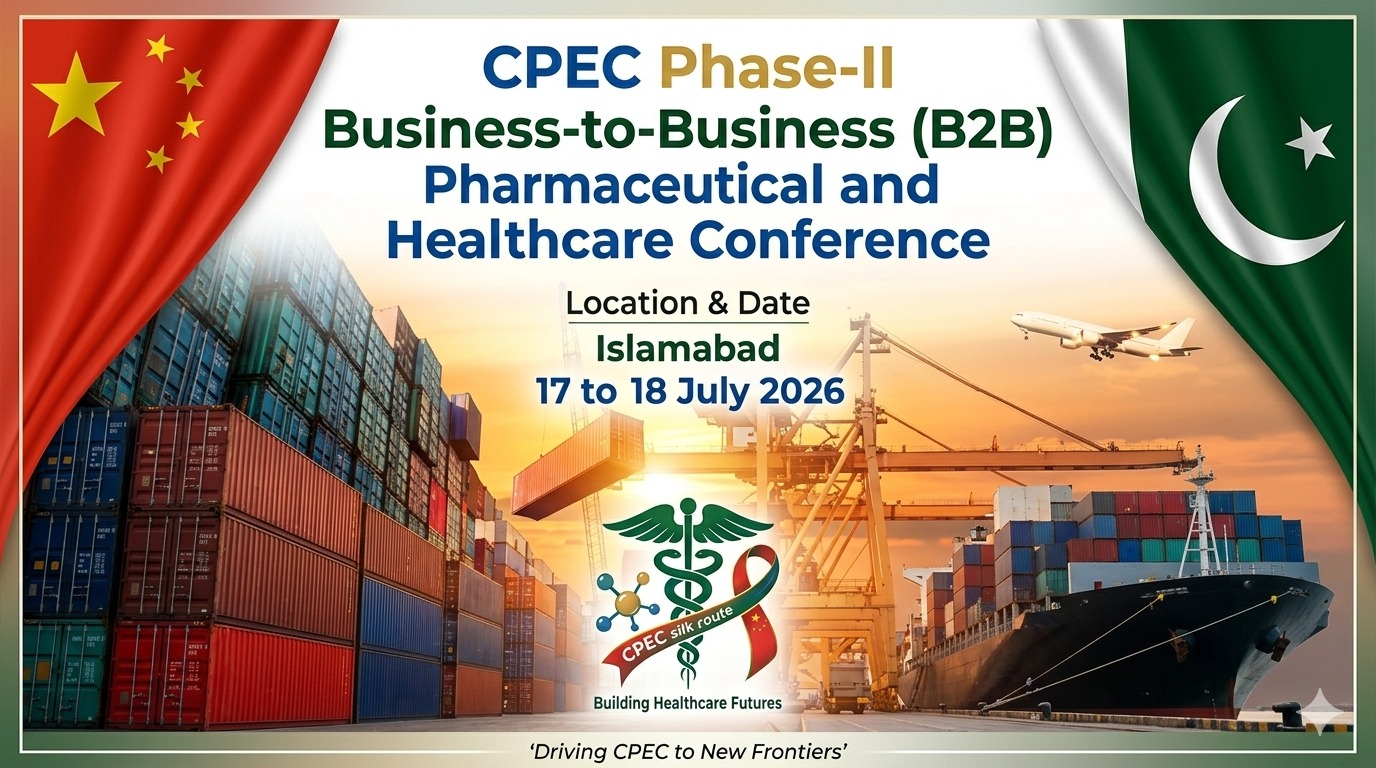
ISLAMABAD (Urdu Times) The framework of Business-to-Business (B2B) Investment Conferences between Pakistan and China has become the main vehicle for accelerating CPEC Phase II through private sector partnerships. Under CPEC Phase II, Islamabad and Beijing have jointly targeted industrial clusters.
Under the Special Investment Facilitation Council (SIFC) and the Pakistani Embassy in Beijing, over $7 billion in investment commitments have been secured so far. The main objective of the entire project is to relocate Chinese industrial units to Pakistan and set up joint ventures.
To further expand the existing economic cooperation, a major B2B Pharmaceutical and Healthcare Conference is being organized in Islamabad from 17 to 18 July 2026, with the Drug Regulatory Authority of Pakistan (DRAP) and the Ministry of Health playing key roles.
Earlier, a dynamic campaign was launched in Beijing under the China Overseas Development Association (CODA). More than 60 leading Chinese biomedical companies are finalizing joint ventures with Pakistani companies for clinical diagnostics, vaccine distribution, and local manufacturing of pharmaceutical raw materials (APIs). The framework, enabled by the Special Investment Facilitation Council (SIFC) and the Pakistani Embassy in Beijing, is accelerating Foreign Direct Investment (FDI), trade partnerships, and technology transfer by directly connecting companies.
This multi-billion dollar investment is supported by three key pillars:
An automated system that eliminates bureaucratic hurdles and provides Chinese companies with quick regulatory approvals. Trading in Renminbi (RMB): Facilitating transactions directly in Chinese currency, which protects the supply chain from foreign exchange fluctuations.
An innovative network to connect companies’ portfolios online ahead of major conferences. Major conferences and industry agreements: The following key forums were held in recent months to enhance private sector collaboration across sectors:
Hangzhou ICT Forum Held in China’s renowned tech hub ‘Zhejiang’, the forum was attended by 214 Pakistani companies and 436 Chinese technology institutions.
In the presence of Prime Minister Shehbaz Sharif, a Memorandum of Understanding (MoU) worth 50 million dollars was signed between Pak-China Investment Company Limited and China Mobile. The main focus of the forum was on artificial intelligence (AI), cloud computing, fintech, local solar panel manufacturing, and lithium-ion battery storage systems.
The agricultural development initiative is introducing advanced Chinese technology in the agriculture sector. Chinese agricultural companies have signed joint ventures in the areas of corporate farming, high-yield seed technology, and smart drip irrigation. Its main objective is to establish a cold chain logistics network to ensure that meat, poultry, and seafood exports from Pakistan meet Chinese standards.
Priority Sectors for Investment: CPEC Phase II focuses on four key industrial clusters: Green energy and transport, Electric Vehicle (EV) assembly plants, local manufacturing of solar panels, and establishment of charging grids. Digital infrastructure: Software development hubs, smartphone and laptop assembly lines, and cloud security. Industrial relocation: Relocating China’s major textile, garment, leather products, and copper refining industries to Pakistan’s Special Economic Zones (SEZs). Food processing: Building infrastructure for packaging, deep freezing, and halal meat processing as per international standards. Incentives available in Special Economic Zones (SEZs): To protect investors and ensure long-term investment, the Government of Pakistan is offering tax incentives: 10-year tax holiday, complete exemption from all corporate income tax for 10 years before the start of commercial production. Exemption from customs duty: Imported goods for industrial use. One-time customs duty and full tax exemption on plant, machinery, and production equipment. Legal guarantee for protection of foreign investment and easy repatriation of profits, dividends, and foreign exchange. Three basic mechanisms have been adopted to speed up the implementation of strategic partnerships in the private sector under the main pillar of CPEC Phase II and the Islamabad Conference:
All NOCs and regulatory approvals are being provided under one roof to Chinese investors, saving them from bureaucratic hurdles.
Direct trade settlement in Chinese currency has been introduced to reduce dependence on the dollar and avoid currency fluctuations.
Companies’ portfolios are interconnected online through the Pakistan Investment Portal even before physical conferences. The recent conference, the ICT Forum (May 2026), Hangzhou, China, 214 Pakistani and 436 Chinese companies participated.
China Mobile and Pak China Investment Company signed a $50 million (50 million) deal.
Agritech B2B Conference (January 2026), Islamabad, Pakistan: Corporate farming, smart irrigation, and cold chain logistics agreements for exporting halal meat and seafood to China
Pharma & Biotech Summit July 2026 Islamabad, Pakistan: Over 60 Chinese medical companies arrive. Focus on pharmaceutical raw materials (APIs), vaccine manufacturing, and local assembly of diagnostic devices,Electric vehicle assembly plants, and lithium-ion battery storage systems to be manufactured in Pakistan. Industrial relocation, shifting of Chinese textile, garment, leather, and copper refining factories to Pakistan’s Special Economic Zones such as Rashakai and Dhabeji, cloud computing, artificial intelligence (AI), fintech, and smartphone manufacturing. Incentives under Special Economic Zones (SEZs): The government is providing legal protection to bring Chinese companies to Pakistan and promote the local private sector.
It may be recalled that in the context of CPEC Phase II, the Prime Minister of Pakistan has said that Pak-China friendship is deep and eternal. This friendship is embedded in the hearts of the people of both countries. The relationship of all-weather strategic cooperation stands the test of time. Over time, bilateral cooperation between China and Pakistan has reached a new high with the addition of new dimensions of cooperation in multi-faceted areas under the China-Pakistan Economic Corridor (CPEC) framework, which is a principled strategic component of the Belt and Road Initiative. We highly appreciate President Xi Jinping’s continued support. President Xi Jinping and Premier Li Keqiang are committed to ensuring the high-quality development of the China-Pakistan Economic Corridor initiatives with Pakistan and taking it to new heights. It may be recalled that in this context, Chinese President Xi Jinping had said in his previous message that the friendship between China and Pakistan is based on trust and mutual cooperation, and we have been friends in both good times and difficult times. Our friendship is a fast-track for the harmonious relations between the countries. First, we should strengthen mutual cooperation and deepen strategic cooperation. We should maintain the good tradition of frequent high-level visits and meetings, work together on major strategic issues, and support each other on issues of our respective core interests and major concerns. Second, we should advance our common interests and achieve common development. We should use the China-Pakistan Economic Corridor to advance our practical cooperation, focusing on Gwadar Port, energy, infrastructure development and industrial cooperation, so that the fruits of its development reach all the people of Pakistan and the people of other countries in our region. Third, we should enhance close exchanges to build lasting friendship. This year is the year of China-Pakistan friendly exchanges. We should hold various and colorful celebration events and encourage more contacts and exchanges between young Chinese and Pakistanis. In the next five years, China will provide 2,000 training opportunities for Pakistan and train 1,000 Chinese language teachers for Pakistan. Fourth, we must stand together in the face of difficulties and jointly confront security challenges. China will work with Pakistan to deal with non-traditional security threats to provide a reliable security guarantee for bilateral economic cooperation and common development. The Chinese nation loves peace. China will continue to pursue win-win cooperation and promote friendship and cooperation with other countries. It will adhere to the policy of relationship, sincerity, mutual benefit and inclusiveness. It will further deepen win-win cooperation with its neighbors to bring them more benefits through its own development. China will continue to implement the win-win strategy of opening up to build an open economy. This will create new development opportunities and space for both Asia and the world. We will strengthen cooperation with countries along the land and maritime Silk Roads, so as to jointly build an open platform for cooperation and create new momentum for achieving sustainable development in relevant regions. Building a China-Pakistan community of shared future is a strategic decision made by our two governments and peoples. Let us work together to create a bright future for China and Pakistan. It may be recalled that the Board of Investment (BOI) had termed the Pakistan-China Agriculture Investment Conference (PCAIC) held in Islamabad on January 21 as a historic milestone for agricultural cooperation and technology transfer under CPEC Phase-II. The high-level forum held at Serena Hotel, Islamabad, was attended by government officials from both countries, Chinese and Pakistani private companies, and agricultural experts. During this B2B event, investment opportunities and trade agreements worth over $1.345 billion (1.345+ billion USD) were finalized in Pakistan’s agriculture and livestock sectors. The Federal Minister for Investment and BOI officials clarified that this conference is a link to making Pakistan an important supply hub for China’s value-added market. Minister for Planning, Development and Special Initiatives Ahsan Iqbal said that in 2013, the then Prime Minister of Pakistan Mian Muhammad Nawaz Sharif visited China, where on July 5, 2013, a historic Memorandum of Understanding for the China-Pakistan Economic Corridor (CPEC) was signed in the presence of the Prime Ministers of both countries. The MoU launched a series of economic activities that could prove to be a game-changer for the entire region and improve the lives of nearly 3 billion people in China, Central Asia, South Asia and the Middle East.
The all-weather strategic cooperative partnership between the two countries has been expanded under the China-Pakistan Economic Corridor framework, which is a principal strategic component of President Xi’s Belt and Road Initiative. With the joint efforts of the leadership of both countries, the first phase of CPEC has been successfully completed. The China-Pakistan Economic Corridor has entered its second phase, which includes several new areas of cooperation, including industrial development, agriculture, science, and information technology cooperation. The China-Pakistan Economic Corridor (CPEC) is a reflection of the enduring friendship between Pakistan and China, a partnership deeply rooted in mutual trust, respect, and shared aspirations. At its core, the CPEC embodies a vision of connectivity, development, and economic empowerment for our people. It is a catalyst for job creation, skill development, and technology transfer, empowering our youth and promoting innovation-led growth. Through strategic cooperation with Chinese partners, we are nurturing human capital, increasing productivity, and equipping our workforce with the skills needed to thrive in the 21st century global economy. The CPEC is more than just a corridor of roads and bridges. It is a path to prosperity, stability, and shared prosperity for generations to come. The global economic landscape has changed dramatically. The main drivers of this transformation are technology, trade liberalization, free movement of capital, advances in communication and transportation infrastructure, and the creation of cross-border supply chains. Emerging economies are growing at a much faster pace than developed economies, and the center of gravity of the global economy has shifted eastward. Regional cooperation agreements have been promoted and strengthened in recent times, especially to achieve this change in the global economic landscape. Let us resolve to stand together as a nation to warmly welcome our Chinese counterparts at this historic juncture and to create a conducive environment for them to fulfill their ambitions of making the China-Pakistan Economic Corridor one of the most transformative projects of the 21st century.The federal government has taken the final decision to merge the Board of Investment into the Special Investment Facilitation Council to make the foreign investment system in Pakistan fast-paced, effective and investor-friendly. Keeping in mind the priorities of Prime Minister Shehbaz Sharif’s visit to China in May 2026 and CPEC Phase-II, orders were issued to expedite the process of this organizational merger. In the past, the Board of Investment was the primary civil institution for promoting investment in Pakistan; however, due to multi-faceted bureaucratic approvals and delays in NOCs, investor confidence was being shaken. After the establishment of SIFC, decision-making was greatly accelerated through military-civilian collaboration, including the public and private sectors. Now the aim of merging the two institutions is to give full legal and administrative autonomy to the “Single Window Operation” so that billions of dollars of investment coming from the Gulf countries and China can be implemented without any delay. After the merger, full control of investment policies and implementation has been entrusted to SIFC, under which the following changes are being made: SIFC now has full leadership in attracting foreign direct investment and running the federal agenda. The supervision, allotment, and regulatory reforms of all Special Economic Zones across the country, such as Rashakai, Dhabeji, etc., are now under the jurisdiction of SIFC. The responsibility for the implementation of the Foreign Investment Act 2022 is also now part of the new mandate. The merger is specifically designed to enhance Pak-China Business-to-Business (B2B) collaboration. The Chinese government and private corporate entities there no longer need to go through separate ministries or BOI. Acceleration of industrial relocation: Land allocation and tax exemption certificates for textile, pharma, and agri-tech units moving from China to Pakistan will be issued within a few days. On the instructions of the Prime Minister, SIFC has been tasked with preparing a comprehensive and long-term roadmap. Establishment of one-stop centers at the provincial and federal levels where representatives of all departments are present under one roof. Simplification of duty structure on import of raw materials and industrial machinery. Ensuring issuance of visas within just 24 hours to businessmen and investors registered through SIFC. Experts are calling this merger the best way to increase investor confidence and eliminate bureaucracy. The real success of this organizational change will depend on consistent policies, legal transparency, and practical provision of an international business environment.