 E Paper
ISLAMABAD (Urdu Times) Middle East War, The Strategic Role of the Prime Minister of Pakistan,

Share
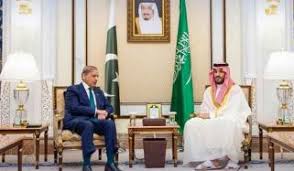
ISLAMABAD (Urdu Times) Pakistan is hopeful of resolving the current crisis in the Middle East with the help of the Muslim Ummah. The government of Prime Minister of Pakistan, Shehbaz Sharif, is making every possible effort to stop the Iran war. Iran has been given a message to adopt the path of negotiations and avoid reaction so that the scope of the war does not widen. The role of the Prime Minister of Pakistan was revealed during the Middle East war. Shehbaz Sharif has also contacted various heads of state. On the other hand, Prime Minister Shehbaz Sharif has called a meeting of parliamentary leaders on the global situation today. Speaking to several Gulf leaders on Saturday, Prime Minister Shehbaz Sharif offered Pakistan’s constructive role in promoting peace amid the growing crisis in the Middle East following the US and Israeli attacks on Iran and Tehran’s retaliatory attacks on regional bases. The Prime Minister said in a statement shared on X that “I spoke to my beloved brother HRH Crown Prince Mohammed bin Salman this evening to discuss the Israeli attacks on Iran and the resulting attacks in the Gulf region.” “Pakistan stands in complete solidarity with Saudi Arabia and our brotherly Gulf countries in this difficult time. We stand ready to play a constructive role for peace and pray that the blessings of Ramadan bring peace and stability to our region,” he said. The Prime Minister expressed grief over the tragic death of a Pakistani citizen in a missile attack on Abu Dhabi. He assured the leadership of the UAE of Pakistan’s solidarity and support in the current crisis and said that Pakistan “will always stand by our Emirati brothers and sisters, in line with the close brotherly relations between the two countries, which have stood the test of time.” Meanwhile, the Prime Minister also spoke to the Emir of the State of Qatar, Sheikh Tamim bin Hamad Al Thani. The Prime Minister strongly condemned the serious tension in the region caused by the Israeli attack on Iran, which was followed by regrettable attacks on Qatar as well as other Gulf countries. Prime Minister Shehbaz Sharif also spoke on the phone with the President of the United Arab Emirates and Ruler of Abu Dhabi, Sheikh Mohammed bin Zayed Al Nahyan. Foreign Minister Ishaq Dar told media representatives that as soon as the attack took place, he immediately contacted Iranian Foreign Minister Abbas Araqchi and held talks with the foreign ministers of Palestine, Iran, Saudi Arabia, Bangladesh, Maldives, Oman, the United Arab Emirates, Iraq, Bahrain, and Azerbaijan in the last three days. He said that Prime Minister Shahbaz Sharif also contacted various heads of state to reduce tensions. Pakistan’s effective and balanced role in preventing war in the Middle East is being appreciated all over the world. The Prime Minister of Pakistan is taking a personal interest in this regard, and the international media has already expressed Pakistan’s positive role; even the Iranian ambassador to the United Nations has admitted that Pakistan is the only Muslim country that played its role. Iran’s permanent representative to the United Nations, Amir Saeed Iravani, has specially thanked Pakistan, China, and Russia in the recent emergency meeting of the Security Council. The Iranian ambassador appreciated Pakistan’s “principled and independent” stance on the recent aggression against Iran in the United Nations. According to social media and various news sources, Iran described Pakistan as the only Muslim country that openly raised its voice against the American and Israeli attacks at the international forum and supported Iran’s right to defend itself.’ Pakistan’s Permanent Representative to the United Nations, Asim Iftikhar Ahmed, strongly condemned the attacks on Iran in the Security Council meeting and termed it a violation of international law. Iranian Ambassador to Pakistan Reza Amiri Moqadam also commended the role of the Pakistani government, people, and media, and said that Iran will always remember Pakistan’s diplomatic and moral support in this difficult time. This diplomatic support has further strengthened Pak-Iran relations during the current regional tensions. Iranian Ambassador to Pakistan Reza Amiri Moqadam has said that we can choose friends but not neighbors. Pakistan and Iran are two brotherly neighboring countries.Pakistan and Iran have come closer as a result of changes in the region. On the other hand, 23 years after an American president used American military power against a sovereign state in pursuit of regime change, which plunged the Middle East into chaos and bloodshed for decades, another occupant of the White House has chosen to follow the same dangerous path. With the launch of joint US-Israeli attacks on Iran on February 28, which resulted in the targeted assassination of the country’s Supreme Leader Ayatollah Ali Khamenei, Donald Trump has effectively abandoned his long-standing claims to end America’s perpetual wars.
 They have clearly failed to understand, just as George W. Bush failed before him during the 2003 invasion of Iraq, that regime change plans inherently carry the deepest and most far-reaching consequences. The attack on Iran and the assassination of Khamenei have already triggered a dangerous series of provocations, in response to which Tehran has retaliated against US installations in Gulf countries, including Qatar, the United Arab Emirates, and Saudi Arabia, further increasing regional instability and uncertainty. In fact, the experience of the past two decades has repeatedly demonstrated that externally imposed regime change efforts have only fueled militancy and terrorism, destroyed economies, and further divided already fragile societies, forcing millions of people into long-term displacement, insecurity, and deprivation of basic livelihoods. Worse, their effects are never limited to national borders. The effects of such revolutions and upheavals clearly spread like ripples that destabilize neighboring states and plunge entire regions into chaos, instability, and economic ruin. And as events have shown so far, the same old cycle is being repeated here. Not only have the Gulf states been caught in a widening circle of conflict that has tested their long-term stability for the first time in decades, but their effects are also poised to spill over into directly adjacent geographic regions. At some point, the effects of this tension and pressure may also start to be felt on the Pak-Iran border, and any developments there could be linked to the already unstable security situation in Balochistan and the border areas adjacent to Afghanistan, where internal events in Iran could further aggravate these delicate situations, made even more serious by Tehran’s decision to close the Strait of Hormuz, a vital artery through which about a fifth of the world’s oil supply passes. This move by Tehran could have far-reaching and lasting consequences for the global economy, as oil prices are suddenly rising and global energy markets are being shaken. It is important to make it clear that the justifications being offered for attacking a sovereign country, and for the assassination of its Supreme Leader and other top leaders, cannot be reconciled with the established principles of international law. Under the UN Charter, the use of preemptive military force is permissible only in response to an immediate threat or with the explicit authorization of the Security Council, and these conditions were clearly not met in this case. Furthermore, President Trump’s claims that Iran is bent on building nuclear weapons also do not stand up to any substantive scrutiny. As Oman’s foreign minister made clear, during recent talks with the US, before this pointless provocation sabotaged them, Tehran had agreed never to stockpile enriched uranium. If legal and factual justifications are removed, this US-Israeli action is nothing more than a blatant display of force. This is a war of its own making, in which power has replaced truth and military force has been used in a way that is free from all the legal and moral constraints that were designed to regulate it. It is increasingly clear that Khamenei’s popularity is a profound distortion or a major obstacle to the Iranian state, and this comes at a time when the country has already witnessed violent anti-government protests resulting from decades of economic hardship and repression. The greatest tragedy is that in the midst of this chaos and suffering, the Iranian people are the ones who will bear the brunt. For them, there is no ray of hope on the horizon, and their future seems shrouded in uncertainty, deprivation, and insecurity. It is said that Iran had agreed not to build nuclear weapons. Despite positive progress in the nuclear talks, Iran was attacked, and when Iran was attacked, Pakistan openly condemned it. Earlier, Ishaq Dar said in his speech in the Senate that we are making diplomatic efforts to stop the war with Iran as a duty. He said that the Pakistani people should also understand this.We are committed to our position of a two-state solution for the Palestinians. The Palestinian issue has nothing to do with the current tensions in the Gulf,” he said. “We are ready for all kinds of assistance. We have previously indicated mediation to the US and Iran. If we want this, the parties should talk to each other, whether in Islamabad or in any other country. We want the tension to decrease in some way.” He said, “Regime change in Iran was not our agenda. It is the choice of the Iranian brothers and sisters to whom they give the leadership of their country.” We should fulfill our responsibility as neighbors.’
 Speaking in the Senate session, Foreign Minister Senator Ishaq Dar made a policy statement on the situation arising after the US and Israel attacked Iran and Iran’s retaliatory attacks on various countries. Ishaq Dar said that Pakistan had assured Iran that Saudi Arabia’s territory would not be used for attacks, and it would not be appropriate to misrepresent Pakistan’s sincere diplomatic efforts on the Iran issue within the country. Ishaq Dar told the House that the Iranian leadership is well aware of Pakistan’s efforts. Even when Pakistan held the presidency of the Security Council, we held several discussions on the US-Iran issue. He said that the negotiation process between the US and Iran was going successfully, in which Oman was playing the role of a mediator. There were high hopes that the Iran negotiations were going positively. Meanwhile, Iran was attacked, as it was in June last year. He said that he also met with US Secretary of State Marco Rubio. Iran had agreed not to build nuclear weapons. Pakistan supported Iran’s right to peaceful use of nuclear energy. The US wanted to completely dismantle Iran’s nuclear program, while we convinced Iran to continue its peaceful nuclear program. He said that we were ready to mediate between the US and Iran in Islamabad. Only Pakistan in the world openly condemned the attack on Iran. It was because of our stance that slogans of gratitude to Pakistan were raised in the Iranian parliament. Pakistan clearly condemned the attack on Iran in the Security Council and stressed the need to resolve the issue at the diplomatic level. The Foreign Minister said that in response to the attack by the US and Israel, Iran attacked the Gulf countries. Iran said that they were attacking US bases and that airports there were hit. We should not get involved in this conflict. If these countries had not been attacked, we would have raised our voice against the US and Israel. We know that there is resistance, but we condemned it in 15 minutes. In the Senate meeting, Ishaq Dar said that after 12 years, a resolution was passed unanimously in the United Nations Security Council. There is no lack of effort by the government to negotiate. We are fully on board. Iranian Foreign Minister Abbas Araqchi and I are in direct contact. We do not need the Foreign Office for communication. It was said that we stood with a resolution in the Security Council, which asked for the lifting of sanctions on Iran, Pakistan was thanked in the Iranian parliament, we held an emergency meeting of the Security Council on February 28, we took advantage of our Security Council membership, we condemned the attack on Iran there, expressed solidarity with Iran along with Arab countries, and asked everyone to show restraint, international peace and security is weakening, what happened in two or three days should not have happened. Federal Defense Minister Khawaja Asif, while issuing a strong warning regarding the growing conflict in the Middle East, called Zionism a threat to humanity and alleged that there is a coherent agenda to destabilize the country by spreading Israeli influence to the borders of Pakistan. In a statement released on his social media account, he said that the agenda of the war against Iran includes bringing Israeli influence to Pakistan’s doorstep. Explaining his position, the Federal Minister said that the Zionist ideology has held the world’s economic systems and major powers hostage for a century. He has linked every major disaster that has occurred in the Islamic world since the establishment of Israel to this influence. The federal minister said that Zionism is a threat to humanity. From the establishment of Israel on the land of Palestine to this day, whatever calamity has befallen the Islamic world or whatever war has been imposed, the hand of the Zionist ideology and state will be seen directly or indirectly behind it. Zionism has been controlling the world’s economic system for a century, and world powers are held hostage by Zionism.Speaking on the regional crisis, the Defense Minister claimed that the war imposed on Iran despite Tehran’s willingness to sign a diplomatic agreement is actually part of a broader plan prepared under Zionist auspices to undermine Pakistan’s sovereignty. The aim of the current tension is to establish a single-point agenda by involving neighboring countries so as to create an atmosphere of hostility on all of Pakistan’s borders. Khawaja Asif warned that the ultimate goal of this conspiracy is to compromise Pakistan’s security and make the country a subordinate state. He added that despite Iran’s willingness to sign the agreement, war was imposed on them, and this agenda, prepared by the Zionists, includes bringing Israel’s influence directly to Pakistan’s borders. After this, the joint ‘single-point agenda’ of Afghanistan, Iran, and India will be hostility towards Pakistan, which aims to make our borders insecure, surround us with enemies from all sides, and make Pakistan a subordinate state. He urged the 250 million people of Pakistan to put aside political and religious differences and understand the intentions of the eternal enemies. The Defense Minister paid great tribute to the country’s military strength and status as a nuclear power, which he attributed to the bravery of the martyrs and the political determination of former Prime Minister Nawaz Sharif. He saluted the courage of Nawaz Sharif, who established Pakistan’s defense system by carrying out nuclear explosions. He noted that the strength of our armed forces is recognized worldwide, which is acting as a basic shield for the country’s sovereignty in these difficult circumstances. The Federal Minister appealed for unity among the Muslim world so that common threats can be recognized. He expressed solidarity with the cause of a free Palestine and prayed for the continued strength and security of Pakistan and its defenders. President Trump’s administration officials told a briefing to congressional staff that there was no intelligence information that Iran was preparing a preemptive strike against the United States. The US news agency cited three people familiar with the briefing, who spoke on condition of anonymity. Two of them said that administration officials acknowledged that there was a greater threat from Iranian missiles and proxies than previously thought. However, a third source said that administration officials emphasized that Iran’s missiles and proxies pose an immediate threat to American personnel and its allies in the region. The sources also said that the officials did not provide any details on what else would happen in Iran after the joint US-Israeli attack. It has been said that the information given to the congressional staff contradicts President Trump’s message. The US president said in a video message after the attacks began that ‘our goal is to eliminate the threat posed by the Iranian regime and to defend the American people.’ Similarly, a senior Trump administration official said that there were indications that the Iranians could attack.
 A source familiar with the operation said that for several weeks before the operation, Israeli and US officials had been monitoring the movements of senior Iranian leaders, including Supreme Leader Ayatollah Ali Khamenei, and then shared information that made the daylight attacks possible. Three attacks took place in three locations in one minute, killing Khamenei and about 40 senior officials, including the head of the Revolutionary Guards and the defense minister. The official also said that ‘multiple factors combined to create a golden opportunity in which as many Iranian leaders as possible were targeted.’ The Gulf Cooperation Council (GCC) Ministerial Council has reaffirmed the right of Gulf states to respond to any aggression. The meeting was attended by Saudi Foreign Minister Prince Faisal bin Farhan, foreign ministers of member countries, and the council’s Secretary General Jassim Al-Badawi. The Iranian missile and drone attacks that began on Saturday, February 28, on the UAE, Bahrain, Saudi Arabia, Oman, Qatar, and Kuwait were discussed. The international community was urged to “strongly condemn the Iranian attacks,” and the government has decided to take the parliamentary leaders of the National Assembly and Senate into confidence on the situation arising from the attack on Iran. The Prime Minister of Pakistan has decided to take the parliamentary leaders into confidence on the situation in the Middle East. The in-camera briefing will be held at 11:30 am today. The responsibility of coordination for the briefing has been given to Rana Sanaullah. It should be noted that the war started by the US and Israel has now spread throughout the Middle East. The Iranian Revolutionary Guards targeted the US base in Bahrain. 20 drones and 3 missiles were fired at 20. US Centcom claims to have destroyed the Revolutionary Guards’ control and command center. Iranian missile launch sites and other targets were also targeted. The US embassy in Saudi Arabia was also attacked by drones. Meanwhile, attacks are also being exchanged between Israel and Hezbollah. Israeli planes bombed Beirut heavily. 59 Lebanese towns issued evacuation warnings. Hezbollah also carried out drone attacks on Israeli airbases. 13 Iranian Revolutionary Guards personnel were killed yesterday.