
 E Paper

ISLAMABAD (Urdu Times) 800 MILLION LESSON: HOW CHINA COME OUT FROM POVERTY AND CAN INSPIRE PAKISTAN?

Share
Written By Ms. Areeba Dildar, a Participant of ICSF-HU Fellowship Programme 2026-2027
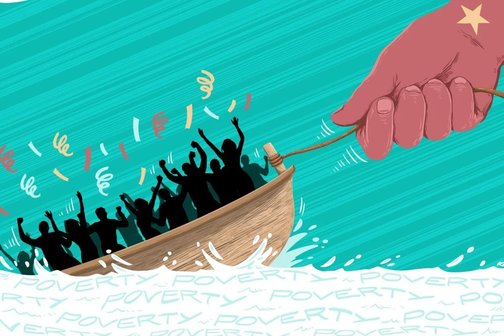
ISLAMABAD (Urdu Times) China declared a victory over the absolute poverty in 2021.Roughly 800 million peoples lifted from poverty (World Bank, 2022). Since 1978 and more than three quarters of the world i.e. 75 percent of global poverty reduced. It was the one of the most developmental achievements in the history of the world where a country announced complete poverty reduction. The second figure tells a different story. According to the World Bank’s upper-middle-income poverty line of $8.30 a day, 15.2% of China’s population, or about one in seven people, still lived below this level in 2024. Both figures are correct, but they measure poverty in different ways. Understanding the difference between them can offer valuable lessons for other developing countries seeking to reduce poverty and improve living standards.
Poverty is not a fixed condition., it is a threshold. The World Bank maintains several $1.90 a day for extreme poverty, $3.20 for lower-middle-income countries, $5.50 and $8.30 for upper-middle-income countries. China’s own national line in 2021 stood at roughly $2.30 a day. And how China done this it’s because of two engines. The first engine was growth. The World Bank has pointed the China’s reform and developmental programs as the foundation for the rapid growth that allowed people to lift themselves out of poverty. As factories, trade and cities expanded, the urban population rose from 200 million in 1980 to 933 million in 2023, and millions of them found better work. Economic Growth alone does not benefit equally to everyone. People living in remote mountain villages and farming communities may still struggle, even when the country’s economy is growing rapidly. To address this problem, China introduced a second approach: providing help according to people’s specific needs.In 2013 China focused more on identifying poor people and provide sustainable support. Instead of relying only on national poverty figures, officials looked at each family’s situation and identified what they needed to improve their lives. For some families, the solution was building a road. Others needed access to education, better healthcare, or help selling their agricultural products.
What I find out more interesting is China did not treat poverty as just a lack of money. The government first understood the reason of poverty than initiate the programs to improve people’s quality of life. Therefore, it invested in education, health insurance, better housing, clean drinking water, and rural roads. According to the World Bank, health insurance in China was expanded to cover almost all citizens, making healthcare more accessible. The progress is also reflected in people’s incomes. In previously poor counties, rural residents’ average disposable income rose from 6,079 yuan in 2013 to 16,396 yuan in 2023. China also announced that, by the end of 2020, nearly 100 million rural people across 832 counties had been lifted out of poverty under its national poverty standard.
For Developing Countries China’s experience offers three important lessons. Developing countries can learn three key lessons: First, measure poverty clearly and share accurate data. Second, strengthen agriculture and industries before expanding social support. Third, combine economic growth with targeted help for people who need it most, because growth alone cannot end poverty. However, running these programmes successfully requires strong institutions and effective government systems, which take time to develop.
In case of Pakistan, it also faces the challenges and now 16.5% of Pakistan’s population falls below extreme poverty line. Shockingly, the World Bank noted that Pakistan accounts for 48% of the extreme poor across the expanded Middle East, North Africa, Afghanistan, and Pakistan (MENAAP) region. Floods, inflation, unemployment, price pressures ETC have tested many families. But Pakistan also has a strong foundation to build on, and China’s experience suggests several practical ideas. But there important part of China’s success was strong follow-up in villages. Pakistan could strengthen local teams, such as community coordinators and agricultural extension workers, Education and technical training etc may help in the reduction of poverty.
This 800 million is not just the figure it gives us a lesson that development is a long road with milestones along it, and that milestones only mean something if we understand the road. 800 million are individual families who gained a road, a clinic, a classroom or a market.so there is hope for Pakistan too, poverty can be reduced quickly with the economic growth, targeted government support, and long-term efforts at the local level work together. Pakistan has a opportunities, including social support programmes, a large young population, and growing international partnerships. It does not need to start from scratch. Instead, it can develop its own approach based on its needs and challenges. China’s experience shows that meaningful progress is possible when a country makes poverty reduction a long-term priority and continues working towards it.
References
- World Bank. (2022). Four Decades of Poverty Reduction in China: Drivers, Insights for the World, and the Way Ahead. https://thedocs.worldbank.org/en/doc/bdadc16a4f5c1c88a839c0f905cde802-0070012022/original/Poverty-Synthesis-Report-final.pdf
- World Bank. (2022, April 1). Lifting 800 Million People Out of Poverty: New Report Looks at Lessons from China’s Experience. https://www.worldbank.org/en/news/press-release/2022/04/01/lifting-800-million-people-out-of-poverty-new-report-looks-at-lessons-from-china-s-experience
- National Bureau of Statistics of China. (2021). Statistical Communiqué of the People’s Republic of China on the 2020 National Economic and Social Development. https://www.stats.gov.cn/english/PressRelease/202102/t20210228_1814177.html
- World Bank. (2025, September 22). Pakistan: Bold, Sustained, People-Centered Reforms Needed to Reduce Poverty, Build Resilience, and Protect Vulnerable Populations. https://www.worldbank.org/en/news/press-release/2025/09/22/pakistan-bold-sustained-people-centered-reforms-needed-to-reduce-poverty-build-resilience-and-protect-vulnerable-populat
- AMRO, An exemplary journey in eradicating poverty
- Geo News, Pakistan’s poverty conundrum