 E Paper

ISLAMABAD (Urdu Times) Defence Day 6 September; Invincible capability, eternal sacrifices, challenges

Share
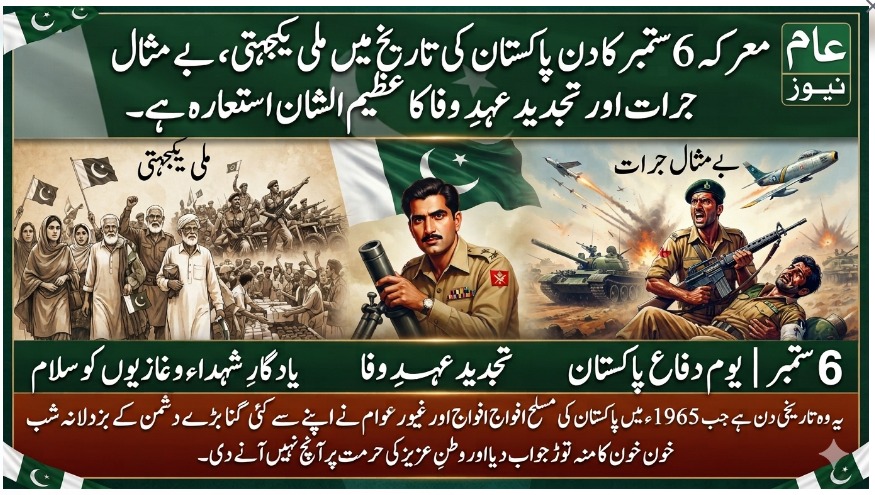
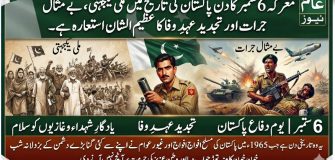
ISLAMABAD (Urdu Times) The 1965 Pak-India War is a glorious chapter in Pakistan’s military and national history, when the country’s armed forces and the entire nation, displaying unparalleled courage and solidarity, thwarted the evil intentions of an enemy many times larger than themselves. This war lasted from 6 September to 22 September 2026, i.e. a total of 17 days, which ended with a ceasefire following the intervention of the United Nations (UN) and later with the “Tashkent Agreement”.
Every year, the entire nation celebrates 6 September with great enthusiasm and dignity. This day is a day to pay tribute to the heroes and martyrs of the 1965 war who thwarted the evil intentions of an enemy many times larger than themselves.
This day reminds us that when the nation and the army are on the same page, no power in the world can harm this country.
This day is celebrated in memory of the martyrs and ghazis who laid down their lives defending the beloved homeland in the 1965 Pak-India war.
The defense of Pakistan refers to the comprehensive system of protecting the geographical borders, ideological identity, airspace and maritime borders of the Islamic Republic of Pakistan, the responsibility of which lies primarily with the Pakistan Armed Forces and the country’s security agencies. Pakistan’s defense has been built on very strong, modern and scientific foundations due to the geopolitical situation and security challenges of the region.
For any free and sovereign nation, its defense is as important as breathing. The Islamic Republic of Pakistan is located in a very important and sensitive region of the world in terms of geography and ideology. The defense of Pakistan is not just about protecting a few borders, but it is about protecting the ideology, culture and freedom for which millions of Muslims of the subcontinent made eternal sacrifices. Today, in September 2026, Pakistan’s defense system is considered one of the most advanced and impregnable systems in the world.
Pakistan’s defense capability is divided into three basic parts:Pakistan Army: One of the best land forces in the world, which is always ready to protect the eastern and western borders, internal security and eliminate terrorism.
Pakistan Air Force (PAF): The protector of the country’s airspace. With the slogan “Second to None”, the Pakistan Air Force is known worldwide for its professionalism and technical superiority (such as the JF-17 Thunder and J-10C aircraft).
Pakistan Navy: Ensures the security of Pakistan’s maritime borders and maritime trade routes, including Gwadar Port under CPEC.
Pakistan became the first in the Muslim world and the world’s 7th recognized nuclear power on May 28, 1998. Pakistan’s nuclear program is purely for defensive purposes and to maintain the balance of power in the region (Credible Minimum Deterrence). Modern ballistic and cruise missile systems like Ghauri, Shaheen, and Ababeel make this defense impregnable. The methods of warfare have changed in the 21st century. Now countries are targeted not only with conventional weapons, but also through cyber attacks, propaganda, and fifth-generation warfare. Pakistan has expanded its defense capabilities to deal with these modern threats.
The formal start of the war took place on the morning of September 6, 1965, when Indian forces violated the international border and launched a surprise attack on the fronts of Lahore, Sialkot, and Kasur without any declaration of war.
India’s plan was to capture Lahore and celebrate the victory at the Gymkhana Club, but the soldiers of the Pakistan Army sacrificed their lives and stopped the enemy at the BRB Canal. Important fronts and historical battles of the war; The 1965 war was fought on many fronts, some of which were written in golden letters in the military history of the world: Lahore Front and the bravery of Major Aziz Bhatti: On the front of Barki, Major Raja Aziz Bhatti blocked the path of enemy tanks and troops for five days and nights continuously. He refused to retreat and was martyred. For this great bravery, he was awarded Pakistan’s highest military award, Nishan-e-Haider.
Chonda (Sialkot) – The biggest battle of tanks: The Sialkot front is famous for the “Battle of Chonda”. This was the biggest tank battle after World War II.
The soldiers of the Pakistan Army tied bombs to their bodies and blocked the path of enemy tanks and turned Chonda into a graveyard of Indian tanks.
Pakistan Air Force Record (MM Alam’s feat): Squadron Leader MM Alam of the Pakistan Air Force shot down 5 enemy warplanes in less than a minute (just 55 seconds) on the Sargodha front, which is still a world record.
Pakistan Navy’s “Operation Dwarka”: The Pakistan Navy successfully targeted and destroyed their most important radar station in the coastal city of Dwarka, India, and paralyzed the Indian Navy. The special thing about this war was that the entire Pakistani nation stood behind its forces. The national songs of Queen Tarnum Noor Jahan warmed the blood of the soldiers. From Karachi to Khyber, every citizen was ready to defend the homeland along with the security agencies.The Indo-Pak war of 1965 not only changed the military relations between the two countries but also the political and diplomatic history of the subcontinent. The most important political and diplomatic outcomes of this 17-day war are as follows:
At the outbreak of the war, the United Nations Security Council immediately mobilized and passed ceasefire resolutions. On September 22, 1965, both countries accepted the ceasefire under international pressure.
During this war, the United States and Britain imposed an arms embargo on both Pakistan and India, which caused greater losses to Pakistan because Pakistan’s defense system depended on American weapons. The former Soviet Union (Russia) played the role of a mediator to end the war and bring peace between the two countries.
Russian President Alexei Kosygin arranged a meeting between Pakistani President Field Marshal Ayub Khan and Indian Prime Minister Lal Bahadur Shastri in Tashkent, the capital of Uzbekistan, in January 1966. Under this agreement, it was agreed that both countries would return to the positions they had before August 5, 1965, and each other’s occupied territories (such as Pakistan’s Chamb Jodiya and India’s Haji Pir Pass) would be returned. During the 1965 war, when the Western powers abandoned Pakistan, China openly supported Pakistan diplomatically and morally. China also issued warnings to India on its borders, which increased psychological pressure on India. After this war, Pakistan reduced its defense dependence on the United States and began close military and economic cooperation with China, which is before us today in the form of CPEC and the modern JF-17 Thunder aircraft. It was signed on January 10, 1966 in Tashkent, Soviet Union (now Russia) to establish peace between the two countries after the 1965 Indo-Pak war. This historic document was signed by Pakistan’s President Field Marshal Ayub Khan and India’s Prime Minister Lal Bahadur Shastri. The main purpose of this agreement was to eliminate the effects of the war and normalize relations between the two countries. The most important clause of the Tashkent Agreement was that the armed forces of both Pakistan and India would return to all positions they had occupied before August 5, 1965 (the start of the war) by February 25, 1966. Under this, both countries agreed to vacate each other’s occupied territories. The leaders reiterated that they would resolve their disputes peacefully in accordance with the United Nations Charter and not use force against each other. Both countries pledged to strictly adhere to the principle of non-interference in each other’s internal affairs. 4. Restoration of Diplomatic Ties: Diplomatic relations severed during the war will be restored immediately and the High Commissioners (Ambassadors) of both countries will return to assume their respective duties. 5. Cessation of Propaganda: It was decided that the media and press of both countries will stop hateful propaganda against each other and will promote an environment conducive to the establishment of friendship and good relations between the two nations. 6. Restoration of Economic & Trade Ties: Steps will be taken to restore trade, economic, communications and cultural relations suspended due to the war. 7. POWs Repatriation: All prisoners of war held by both countries would be immediately released and repatriated. A few hours after the signing of the agreement, on the night of January 11, 1966, Indian Prime Minister Lal Bahadur Shastri died of a heart attack in Tashkent, which made the whole scenario even more serious. The agreement was severely criticized by the people in Pakistan because it resulted in Pakistan returning strategically important areas of occupied Kashmir (such as Haji Pir Pass) to India.The Indo-Pak war of 1965 not only changed the military relations between the two countries but also the political and diplomatic history of the subcontinent. The most important political and diplomatic outcomes of this 17-day war are as follows: At the outbreak of the war, the United Nations Security Council immediately mobilized and passed ceasefire resolutions. On September 22, 1965, both countries accepted the ceasefire under international pressure. During this war, the United States and Britain imposed an arms embargo on both Pakistan and India, which caused greater losses to Pakistan because the Pakistani defense system depended on American weapons. The former Soviet Union (Russia) played the role of a mediator to end the war and bring peace between the two countries. Russian President Alexei Kosygin arranged a meeting between Pakistani President Field Marshal Ayub Khan and Indian Prime Minister Lal Bahadur Shastri in Tashkent, the capital of Uzbekistan, in January 1966. Under this agreement, it was agreed that both countries would return to the positions they had before August 5, 1965, and each other’s occupied territories (such as Pakistan’s Chamb Jodiya and India’s Haji Pir Pass) would be returned. During the 1965 war, when the Western powers abandoned Pakistan, China openly supported Pakistan diplomatically and morally. China also issued warnings to India on its borders, which increased psychological pressure on India. After this war, Pakistan reduced its defense dependence on the United States and began close military and economic cooperation with China, which is before us today in the form of CPEC and the modern JF-17 Thunder aircraft. It was signed on January 10, 1966 in Tashkent, Soviet Union (now Russia) to establish peace between the two countries after the 1965 Indo-Pak war. This historic document was signed by Pakistan’s President Field Marshal Ayub Khan and India’s Prime Minister Lal Bahadur Shastri. The main purpose of this agreement was to eliminate the effects of the war and normalize relations between the two countries. The most important clause of the Tashkent Agreement was that the armed forces of both Pakistan and India would return to all positions they had occupied before August 5, 1965 (the start of the war) by February 25, 1966. Under this, both countries agreed to vacate each other’s occupied territories. The leaders reiterated that they would resolve their disputes peacefully in accordance with the United Nations Charter and not use force against each other. Both countries pledged to strictly adhere to the principle of non-interference in each other’s internal affairs. 4. Restoration of Diplomatic Ties: Diplomatic relations severed during the war will be restored immediately and the High Commissioners (Ambassadors) of both countries will return to assume their respective duties. 5. Cessation of Propaganda: It was decided that the media and press of both countries will stop hateful propaganda against each other and will promote an environment conducive to the establishment of friendship and good relations between the two nations. 6. Restoration of Economic & Trade Ties: Steps will be taken to restore trade, economic, communications and cultural relations suspended due to the war. 7. POWs Repatriation: All prisoners of war held by both countries would be immediately released and repatriated. A few hours after the signing of the agreement, on the night of January 11, 1966, Indian Prime Minister Lal Bahadur Shastri died of a heart attack in Tashkent, which made the whole scenario even more serious. The agreement was severely criticized by the people in Pakistan because it resulted in Pakistan returning strategically important areas of occupied Kashmir (such as Haji Pir Pass) to India.