
 E Paper
ISLAMABAD (Urdu Times) Seventy-Five Years of Pakistan–China Relations: Evolution, Achievements, and Future Prospects

Share

By Ms. Emaan Khan, Project Executive, Pakistan Research Center for a Community with Shared Future (PRCCSF), Islamabad
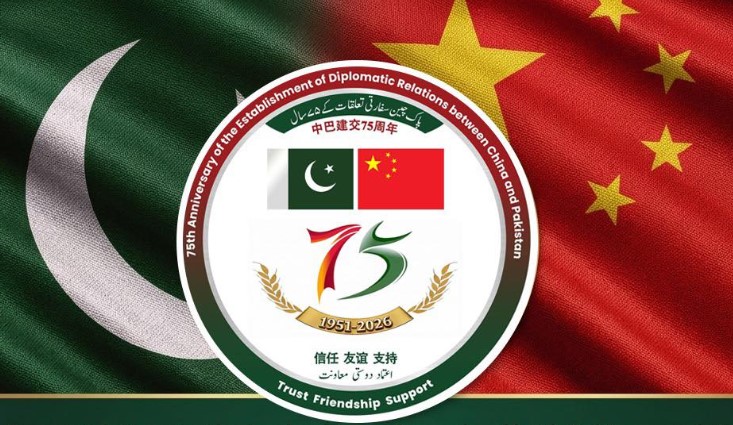
ISLAMABAD (Urdu Times) The year 2026 marks the 75th anniversary of Pak-China diplomatic relations. The bilateral relations whose foundations were laid down in 1951 have now become one of the most reliable and enduring alliances in the modern world. Pakistan was the first Muslim state that recognized the People’s Republic of China. This decades old partnership is based on mutual respect of sovereignty, non-interference in domestic issues, and peaceful coexistence. Throughout these seven and a half decades, the world has witnessed multiple wars, economic crises, revolutions, and shifting geopolitical landscapes. Despite these challenges, Pakistan and China managed to endure every major global change, and their friendship has continued to strengthen, eventually earning the titles of an “Ironclad Brotherhood” and an “All-Weather Strategic Cooperative Partnership”.
A solid political alignment is the basis of this partnership. The two states have been supporting each other in their vital national interests for 75 years. “China always supports” is the phrase that reflects the faith of every Pakistani national in China’s constant support for Pakistan.
China has always respected Pakistan’s territorial integrity and sovereignty while supporting the socio-economic development in Pakistan. Moreover, China can also be seen supporting Pakistan’s stance on regional and international forums. In case of Kashmir issue, China always stood by Pakistan even on world forums including UNO. At the same time, Pakistan has always appreciated China’s initiatives, supported its One-China policy, and consistently stood by Beijing on issues concerning its core national interests.
The two countries closely collaborate on aa wide range of global and regional issues. These include poverty eradication, global governance reforms, counterterrorism, climate change, etc. They also maintain close coordination within multilateral forums such as the United Nations Organization (UNO), Shanghai Cooperation Organization (SCO), and other international platforms. Thanks to this political alignment, social and economic cooperation has been thriving in the favorable environment. Regardless of the challenging moments, the reliability of the consistent support was always obvious. In 2022 when Pakistan was hit by the devastating floods, China was among the first countries to provide aid to Pakistan. In the same way, Pakistan supplied medical supplies and expressed solidarity with China during the COVID-19 pandemic. These actions show that Pak-China relationship is actually founded on mutual respect, support and trust.
The most significant development in Pakistan–China relations in recent decades has been economic cooperation, particularly through the China–Pakistan Economic Corridor (CPEC). Being launched in 2015 as the flagship project of China’s Belt and Road Initiative, CPEC transformed this bilateral relationship into a comprehensive development partnership It brought in massive Chinese investment in Pakistan’s energy, transport and industrial sectors, solving critical shortages in infrastructure and power. Energy projects, under CPEC, added thousands of megawatts to Pakistan’s national power grid through coal, hydropower, solar and wind energy. Projects like Karot Hydropower Project and Sahiwal Coal Power Plant were aimed to address country’s electricity shortages that were hindering everyday life and business. As for transportation, projects like the upgrade of ML-1 railway, construction of motorways, and improvements of Karakoram Highway have reduced travel time and connected isolated areas to the national and foreign markets.
The key element of the long-term strategy of CPEC is the Gwadar Port in Balochistan. With its advantageous location at the junction of South Asia, Central Asia, and the Middle East, it has a potential to become the significant marine and trading hub. China can get access to the Arabian Sea faster due to its deep-water port and improved transportation connections that contribute to Pakistan’s position as a hub for regional trade. Besides Gwadar, Special Economic Zones like Rashakai and Dhabeji attract the investments into industry and manufacturing that create jobs and transfer the technologies. Besides the infrastructure, Pakistan-China cooperation grows in the sphere of the digital economy through 5G, fiber-optic networks, and e-commerce, and in agriculture through hybrid crops and modern irrigation. These programs improve long-term economic integration and interaction between Pakistan and China.
Another pillar of the relationship between Pakistan and China is defense and security cooperation. While the jointly produced JF-17 Thunder fighter aircraft increases the defensive capability and independence of Pakistan, military exercises like “Shaheen” and “Warrior” increase their interoperability. As a tool for promotion of the regional stability and protection of CPEC projects, the cooperation includes information exchange, capacity building, and terrorism prevention. Besides security, cultural and educational cooperation helps to strengthen the interpersonal relationship. Chinese language learning programs keep growing in Pakistan, and thousands of Pakistani students study at the universities of China, mostly in science, engineering, and technology. Sister-cities, direct flights, cultural activities, and media cooperation enhance mutual understanding. Medical cooperation and assistance with vaccinations during the COVID-19 pandemic have shown the humanitarian side of the bilateral relationship thus strengthening the long-term friendship and mutual trust.
The cooperation between Pakistan and China keeps growing in the new dimension of scientific and technological cooperation. Through joint projects related to digital innovation, agriculture, healthcare, renewable energy, and space technology, the long-term cooperation keeps growing. While the investments into digital infrastructure, e-commerce, and IT help with the economic modernization, the Chinese support of Pakistan’s satellite program, advanced agriculture practices, and pharmaceutical studies increase the technological capability. In the future, both sides coordinate their cooperation in the international agenda including artificial intelligence, sustainable energy, and climate resilience. The cooperation with sustainable development goals includes renewable sources like solar, wind, and hydropower, and transportation improvements promote regional connectivity with the Middle East and Central Asia. Moreover, CPEC moves from the infrastructure projects to the industrial cooperation and SMEs thus fostering inclusive growth and innovation.
What makes the Pakistan-China relationship special is that it has remained strong and stable over a long period of time. Usually, in international relations, partnerships change with the changing interests, global environment and the circumstances. However, for 75 years, Pakistan and China have kept on the steady track based on mutual respect, trust, and goals. Wars, economic crises, and regional tensions have tested the consistency of the cooperation, and each time it grew stronger. Due to its reliability, the relation has a unique place in the diplomacy where it is difficult to build and keep the long-term trust.
Conclusion
In essence, the 75th anniversary of diplomatic relations between China and Pakistan reflects not only the spirit of friendship but also the commitment towards working together in the future. From being merely a bilateral relationship of political confidence and economic cooperation through the China-Pakistan Economic Corridor (CPEC), this relation has turned out to be a comprehensive strategic relationship that spans defense cooperation, education, culture, science, and technology. In the coming future, both the countries wish to enhance collaboration in the domains of innovation, sustainability, and connectivity. With such a collaboration among the two countries, founded on trust and shared interests, the stability, development, and peace of the region will continue to grow, thereby allowing both countries to face any future challenges and create prosperity.