
 E Paper
Islamabad (Big Digit) Frontline Guardian of Pakistan’s Cyber Front: Syed Ali Nasir Rizvi

Share
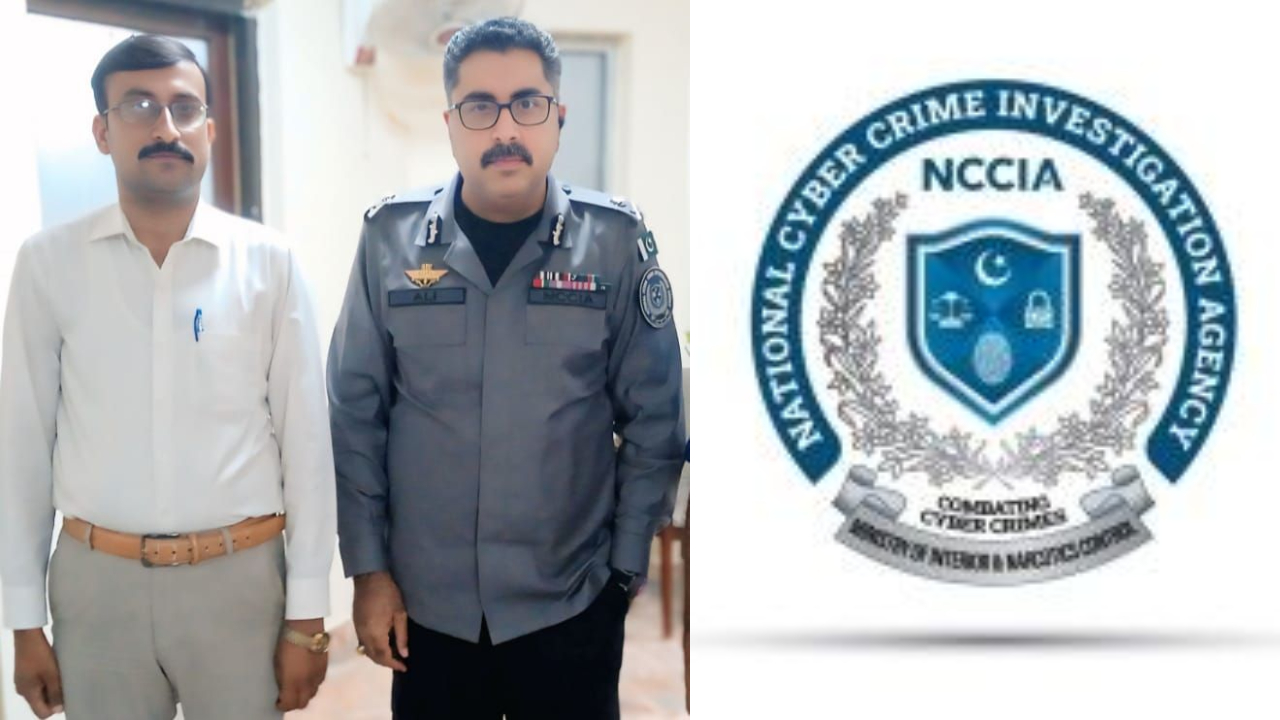
Islamabad (Big Digit) There are two types of police officers. Some complete their tenure and become part of files and official records, while others continue to be mentioned in people’s conversations, the institution’s memory, and public expectations even after their transfers. Some people are recognized by their positions, while others give their positions an identity of their own. Syed Ali Nasir Rizvi is among those officers whose identity has not remained limited to any one chair or position.
In September 2026, when the federal government transferred him from the position of Inspector General of Islamabad Police and appointed him Director General of the National Cyber Crime Investigation Agency (NCCIA), it appeared to be a routine administrative decision, but in reality, it also reflected the changing nature of crime and state priorities in Pakistan. Today, the world of crime is no longer limited to streets, markets, and highways. Criminals can now attack without crossing borders. They do not have a pistol in their hands but a keyboard, and their target is not merely a pocket but also identity, reputation, business, and even national security.
 This is why Syed Ali Nasir Rizvi’s new responsibility is not merely the leadership of an institution but the command of a front that will be counted among Pakistan’s most important fields of internal security in the coming years.
But here a major question arises. Do we really understand the nature of this war?
Whenever security is discussed in Pakistan, the mind immediately turns towards borders, checkpoints, weapons, and uniforms. But the world has changed. Today, tanks are no longer required to weaken states. An organized cyberattack can target a country’s banking system, government records, sensitive information, and public trust. The enemy no longer attacks only from across the border; it can attack through a mobile phone screen, an email, or a fake website.
This is the very war on whose frontlines Syed Ali Nasir Rizvi stands today.
If his tenure in Islamabad Police is to be described in one sentence, perhaps it would be appropriate to say that he tried to make the police not merely a force that responds to incidents but an institution that prepares in advance. If this same thinking is transferred to NCCIA, the institution will not remain merely an office for registering complaints but can become a national shield against cyber threats.
We often criticize institutions, and sometimes that criticism is also justified, but the reality is that the war against modern crime cannot be won by law-enforcement agencies alone. The state, educational institutions, media, banking sector, telecommunications companies, and ordinary citizens also have to play their role. However, there is certainly a central role within this entire system, and at present, Syed Ali Nasir Rizvi is performing that role for NCCIA.
The most dangerous aspect of cybercrime is that its victims are not only weak or uneducated people. Doctors, engineers, journalists, bureaucrats, businessmen, lawyers, teachers, and even technology experts sometimes fall victim to deception. One link, one call, one fake message, or one manipulated video can take away a lifetime’s earnings, reputation, and peace of mind.
This is why today’s police officer must not only know the law but also understand technology. They must not only pursue criminals but also understand the language of digital evidence, data analytics, artificial intelligence, and global cyber networks.
This is also the real challenge before Syed Ali Nasir Rizvi. He has to lead an institution whose battlefield cannot be seen, whose enemies have no specific appearance, and whose fronts remain active twenty-four hours a day.
I have learned one thing in my journalistic life. The public does not expect miracles from an officer. They only want their voices to be heard, their problems to be taken seriously, and to feel that the state stands with them. If NCCIA succeeds in giving an ordinary citizen this feeling, that will be its greatest achievement.
Because real power does not lie only in arrests; it lies in trust.
It is also a fact that Pakistan is a country with a young population. Millions of young people use the internet every day. They study, do business, search for jobs, express their creative abilities, and connect with the world. But dangers also exist in this digital world. Problems such as misinformation, online extremism, financial fraud, harassment, and identity theft are continuously increasing.
In these circumstances, the role of NCCIA is not merely that of an investigative institution but that of a national guardian.
And a guardian does not only act after danger arrives; a guardian also remains alert before the danger arrives.
For Syed Ali Nasir Rizvi, the same will be the measure of success. Can he make the institution more active? Can he create a better balance between modern technology and human capabilities? Can he strengthen the relationship of trust between the public and the institution? And above all, can he prepare this institution for the challenges of the next ten years?
 These questions remain open for now, and time will provide their answers.
But one thing is clear. As rapidly as the world is becoming digital, Pakistan is also entering a new era at the same pace. In this new era, the definition of national security will no longer be connected only with geography; data, information, and cyber protection will also be an essential part of it.
Perhaps future generations, while remembering this era, will say that this was the time when the battlefields were changing. When the appearance of the enemy was changing. When attacks had become silent and defence also had to learn a new language.
At such a time, some personalities no longer remain merely officeholders but become symbols. A symbol of responsibility, a symbol of a challenge, and a symbol of hope.
Today, Syed Ali Nasir Rizvi stands at such a turning point.
Before him is not merely a pile of files but the complex questions of a new world.
Before him are not traditional crimes but the changing threats of the digital age.
Before him is not merely an institution but the trust of millions of Pakistanis.
And this is why, if Pakistan’s changing security landscape were to be captured in a single picture, one name would certainly be among its prominent figures.
Syed Ali Nasir Rizvi — Frontline Guardian of Pakistan’s Cyber Front.